
HPMB Secures Complete Dismissal in Medical Malpractice Appeal
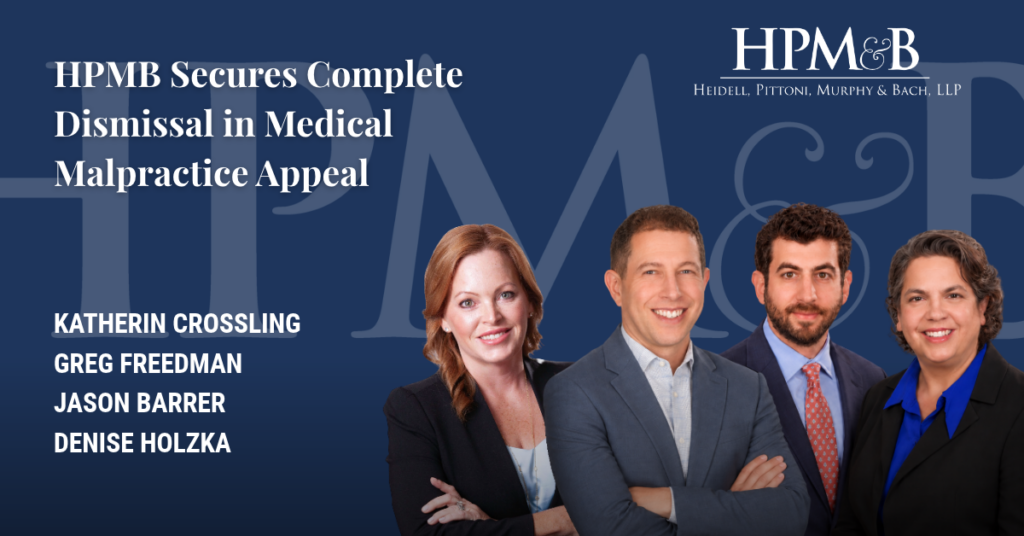
On October 22, 2026, the First Department unanimously reversed the trial court’s underlying order and granted full summary judgment to our clients in a medical malpractice case that spanned two hospital admissions – both at the height of the coronavirus pandemic – and involved claims against more than eight different physicians and nurses.
The plaintiff claimed that his father, who had been rushed to the hospital in April 2020 after missing dialysis, suffered a severe infiltration of vesicant medication into his arm due to the defendants negligently administering it through a peripheral IV line instead of his existing “Permacath” tube. The plaintiff also built on this theory by alleging that the defendants worsened the infiltration through incorrectly taking his blood pressure, that they failed to discover the injury when they should have, and that they improperly discharged him twice without providing the specialist consults or care he needed. According to the plaintiff, this series of alleged failures caused his father to develop widespread necrosis in his arm and require multiple invasive procedures by a plastic surgeon. The plaintiff’s father later passed away from an MRSA infection, which he also claimed had developed due to the defendants’ treatment.
HPMB partners Denise Holzka and Katherin Crossling, and Of Counsel Jason Barrer, secured six affirmations from both treating providers and highly qualified experts in multiple fields of medicine to support defendants’ motion for summary judgment. They obtained dismissal of the plaintiff’s claims for wrongful death, negligent hiring and lack of informed consent, but the trial court ruled that the plaintiff raised triable issues of fact as to all his other theories of malpractice.
HPMB attorney Greg Freedman briefed and argued the appeal before the First Department, successfully demonstrating that none of the plaintiff’s remaining theories could withstand dismissal. We showed that the defendants properly gave vesicant medications through a peripheral IV even knowing that it posed a risk of infiltration, because using the decedent’s Permacath instead could have led to a fatal delay in him receiving emergency dialysis. We also showed that hospital staff could not have discovered the injury any earlier than they did, that the treatments proposed by the plaintiff’s expert were not plausible, and that defendants properly discharged the decedent to minimize the risk of him contracting Covid-19.
The First Department issued a thorough decision, detailing why each of the plaintiff’s remaining malpractice claims failed as a matter of law. Its holding will serve as valuable precedent for all cases where the plaintiff’s experts fail to sufficiently address the medical evidence or the defense experts’ own reasoning on summary judgment.